
Introduction
A client asks a software agency for AI features. The agency's developers can build them, but nobody on the team can design the states that make AI usable: uncertainty, failure, approval before an agent acts and undo. White-label UI/UX design for AI products is design work a partner delivers under the agency's name, so the agency can offer it without hiring designers. This guide helps agency leads decide whether a white-label design partner fits, what it should own and how to verify its work.
A white-label design partner for AI products designs the interaction layer under your agency's brand, hands off build-ready specs to your developers and never contacts or names your client.

Key Takeaways
- A written split naming who owns discovery, specs, AI states and client communication keeps a white-label UI/UX design engagement clear from day one.
- A credible design partner shows shipped AI products with real usage data, because mockups prove taste but not adoption.
- Design lands without rework when it arrives one sprint ahead of developers, built in the agency's own tools.
- Client confidentiality holds only when NDAs, agency-branded deliverables and portfolio exclusion are written into the contract rather than promised verbally.
- AI and agentic features need designed states for uncertainty, failure, approval and undo before users will trust them.
Why Designing for AI Products Breaks Standard Agency Handoffs
Designing for AI products breaks standard handoffs because outputs vary, agents act on a user's behalf and every state needs a design. A static screen spec cannot describe a confidence level, a partial result or an undo.
These states are easier to design alongside the build than to retrofit after it, which is also why getting an AI prototype ready for real users starts before the first sprint.
Four scope items define design for AI in agentic builds:
-
Uncertainty states, such as low-confidence answers and empty results
-
Approval gates before an agent takes an action
-
Progress visibility during long-running tasks
-
Undo and audit trails after the action
A generalist subcontractor often skips these states. The gap tends to surface when real users reach the feature, and your agency answers for it.
Who Owns What in a White-Label AI Design Engagement
The cleanest white-label split gives the partner the design system of record and gives your agency the client relationship. Your agency talks to the end client. The partner never does, unless you invite it into a call under your brand.
| Workstream | Your agency | White-label partner |
|---|---|---|
| Client communication | Leads | None |
| Discovery | Supports | Leads |
| UX flows | Supports | Leads |
| AI states for uncertainty, failure, approval and undo | Supports | Leads |
| Design system | Supports | Leads |
| Developer specs | Supports | Leads |
| Front-end build | Leads | None |
| Design QA on staging | Supports | Leads |
Teams designing and building AI products and services often split further. Your agency owns the model and back end. The partner owns every screen where a human meets the model.
If a client already has a built product that needs design work, the partner can start from existing screens. The reloadux AI products cleanup service turns those screens into production-ready interfaces.
How Three Delivery Models Compare
A white-label partner, an in-house hire and a generalist subcontractor differ most in how quickly they can start, how their cost is structured and how deeply they understand AI-specific design.
| Dimension | White-label AI design partner | In-house AI designer hire | Generalist subcontractor |
|---|---|---|---|
| How quickly work can start | Quickly, once scope and briefing are agreed | Slowly, after recruiting and onboarding | Fairly quickly, but with a learning curve on AI |
| How cost is structured | Per project or embedded with the agency's team | Salary and benefits | Hourly |
| How to verify shipped AI work | Request shipped AI products with usage data up front | Depends on the hire | Often little or none to show |
| Coverage of uncertainty, failure, approval and undo states | Named scope item in the spec | Depends on experience | Frequently omitted |
| Handoff in the agency's sprint tools | Agreed before work begins | Native | Varies |
The pattern: an in-house hire gives control but takes months to ramp. A generalist moves fast but rarely owns uncertainty and approval design. A specialist partner closes both gaps, provided you verify its record.
A partner can work per project or embedded as an extension of the agency's team.
How Designs Land in Your Developers' Sprint Cadence
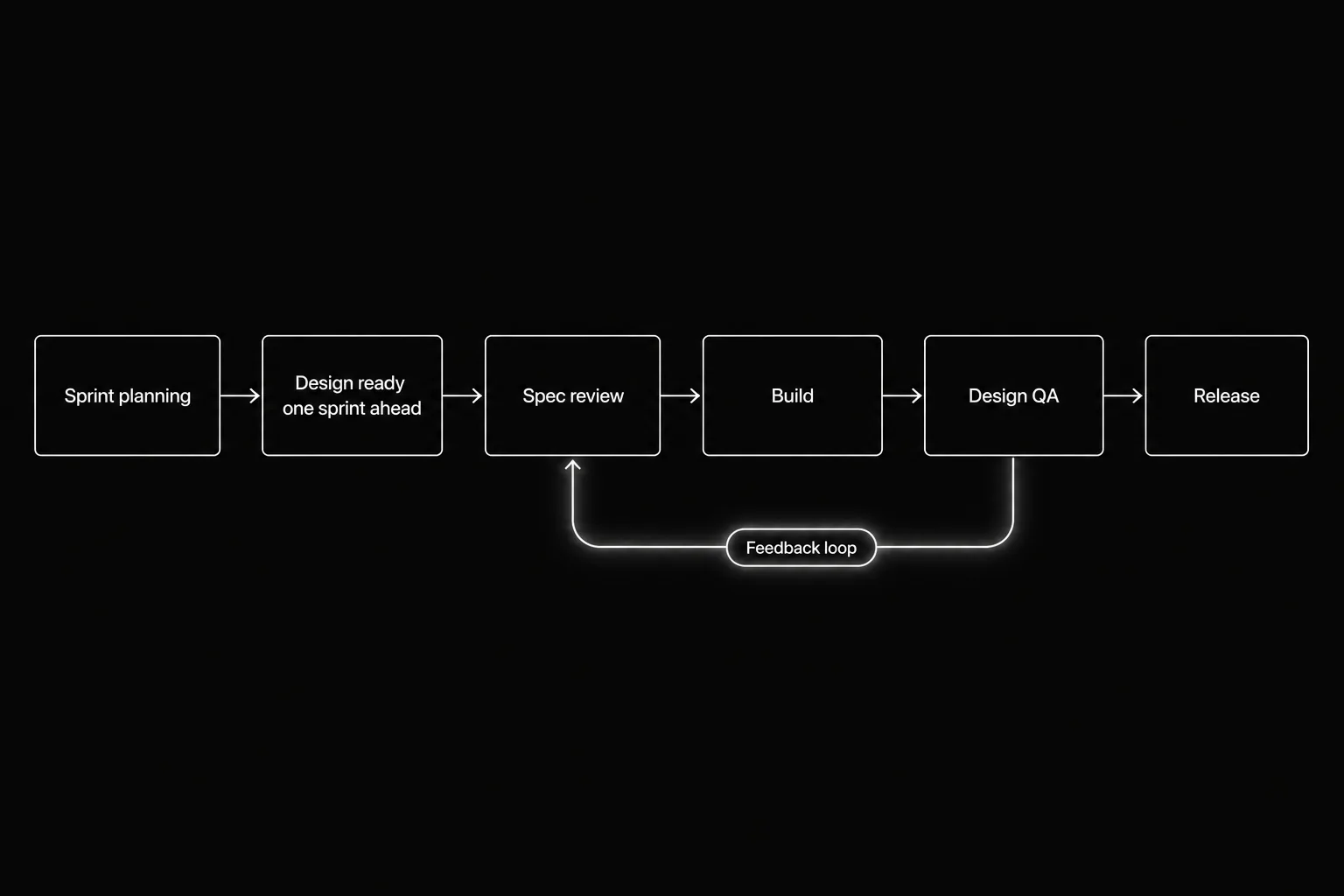
Designs land cleanly when the partner works one sprint ahead and delivers specs in your developers' own tools. That means your component library names, your ticket tracker and your review rituals.
Use this sequence to avoid rework:
-
Share your tech stack, component library and sprint calendar in week zero.
-
Agree on a definition of done for design, including every state of each AI feature.
-
Deliver designs one sprint before build, with annotated states for loading, error and low confidence.
-
Hold a 30-minute spec review with your lead developer before the sprint starts.
-
Run design QA on the built feature before release.
The amount of rework in the first two sprints shows how well the handoff is working.
Common Failure Modes in AI Product Design Handoffs
These four failure modes come up often in AI handoffs, and each has a prevention step that can go into the statement of work.
Missing low-confidence states. The model returns a weak answer and the interface presents it as fact. The risk to the user is acting on a wrong answer without knowing it was uncertain. Prevention: require a spec for every confidence tier, including a fallback message and a path to a human.
Agent actions with no approval gate. An agent sends, edits or deletes without confirmation. The risk to the user is an action taken on their behalf that they never approved. Prevention: define which actions need approval, and design the review step before any build starts.
No undo or audit trail. Users cannot reverse an agent's work or see what it did. The risk to the user is being unable to reverse a mistake or trace what happened. Prevention: ship undo and a readable action log as launch requirements, not later releases.
Designs delivered after the build starts. Developers invent states as they code, and the product drifts from the spec. Prevention: enforce the one-sprint lead and hold the spec review before each sprint.
Criteria for Scoring a White-Label Design Partner
Score every finalist on proof, structure, speed, confidentiality and complexity handling.
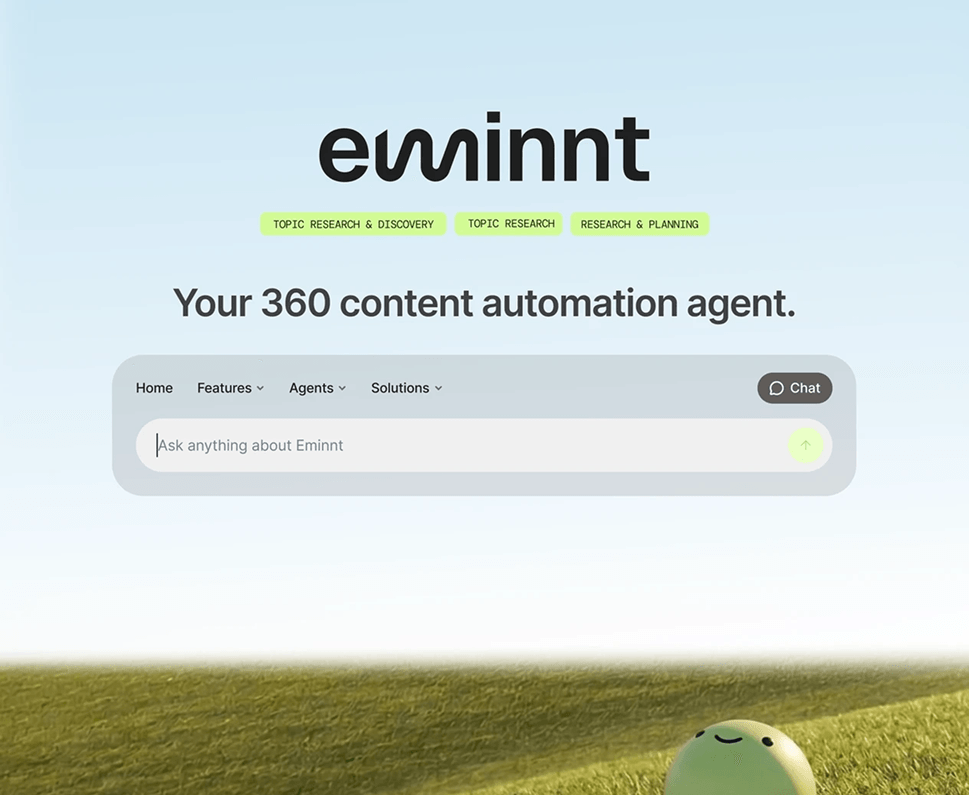
Proof of shipped AI work. Ask each finalist for shipped AI products with real usage data, since mockups show taste but not adoption. Adoption data proves the design held up in production. For reference, see Vocable, where reloadux designed the agentic workflow and trust architecture; it launched at Mindvalley’s AI Summit to 110,000+ attendees and a 300 to 500 percent improvement in content efficiency followed. And see Eminnt, where reloadux designed an orchestrating agent with handoffs, states, review gates and expert approval before publishing.
In-house depth. Ask whether AI interaction design happens in-house or gets subcontracted. A hidden second layer of vendors compounds your risk. Your client is already one step from the designer; a third step multiplies it.
Confidentiality mechanics. Your client stays unnamed through four contract terms: a mutual NDA, agency-branded deliverables, no portfolio listing without written consent and no direct contact. If a partner hesitates on any of these, walk away.
Deadline reliability. Vague scope is a common cause of missed handoffs. Ask for sprint-level delivery dates, a named lead designer and a clause covering missed handoffs.
Speed on complex domains. A good partner learns your client's domain through your briefing and a structured kickoff, not weeks of self-directed research. Ask how it onboarded into fintech, HR tech or healthcare projects before.
Fit with your current designer. If you already have a designer, the partner adds AI-specific capacity rather than replacing anyone. Use it for agent flows and trust patterns your designer has not shipped before.
For more evaluation questions, see Best Design Agency for AI Startups.
Trade-Offs and When White-Label Design Is Not the Right Fit
White-label design adds a coordination layer, and it does not suit every agency. Weigh three limits before you commit.
First, you give up some direct design control. Your agency approves outputs, but the partner owns the craft decisions. That suits teams that value speed over authorship.
Second, the arrangement needs briefing discipline. Thin briefs produce generic output from any partner.
Third, a white-label arrangement does not suit an agency in these situations:
-
The project has no AI interaction layer, such as a marketing website
-
The agency needs a designer embedded full-time in its office
-
The client insists on direct access to the design team and will not accept an intermediary
Agencies building AI-native or AI-powered products tend to gain most, because the interaction layer carries the adoption risk. Agencies whose clients only want a visual refresh gain less. If your agency is still deciding whether outside design help makes sense at all, start with UX consulting services.
About reloadux
reloadux is an AI-native UX and product design studio and part of the Tkxel network. It works with SaaS product teams, AI-native startups and software development agencies, and has delivered 500+ products. It holds a 5.0 rating across 37 reviews (Clutch, 2026).
Conclusion
A white-label partner earns its place when it owns the AI interaction layer, ships specs your developers can build from and stays invisible to your client. Verify it with shipped products, a written ownership split and design QA on staging. That process protects your client relationship and your sprint velocity, and it keeps AI products from shipping with gaps in trust and failure design.
Best for: dev agencies with an AI build in scope, no in-house AI interaction designer and a client who expects your brand on every deliverable.
Not for: agencies needing an embedded full-time hire or projects with no AI interface component.
FAQs

Saliha Shahzad
UI/UX Designer