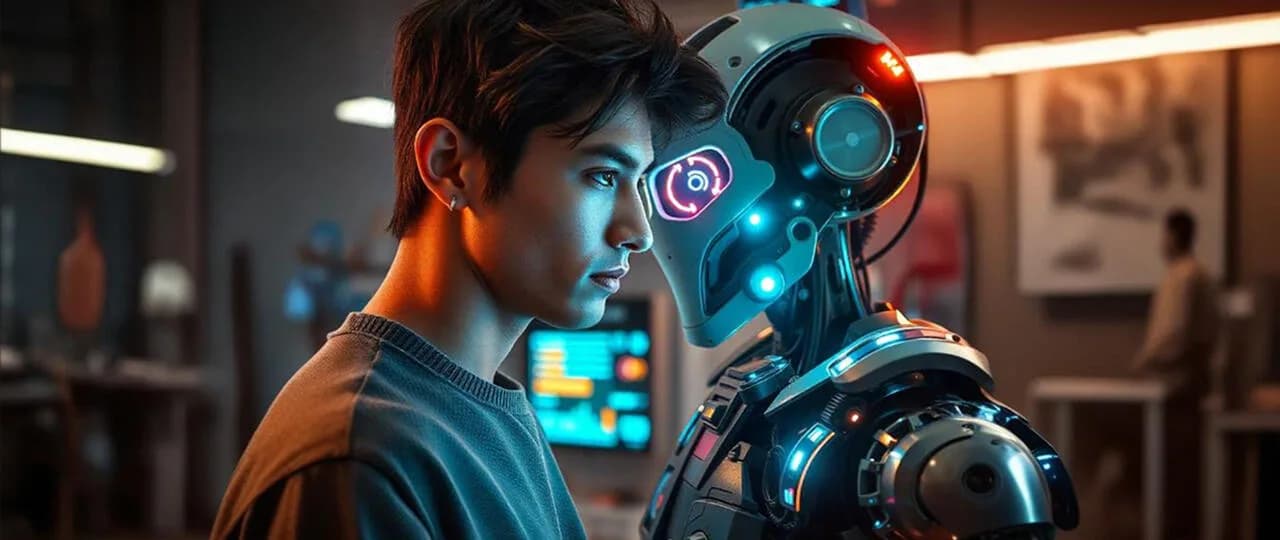
The Role of AI in UX Design Today
AI has changed the landscape of UX design since its inception. It has changed designs by making them more efficient, personalized and insightful. Lets understand how AI is doing this in detail:
- Automation of Recurrent Operations: AI such as ChatGPT helps designers in saving time by automating previously manual tasks. These tasks might include, rewriting microcopies, summarizing user feedback, and generating placeholder text. ChatGPT enables designers to focus on other more important aspects of designing UX.

- AI-Powered Customization in UX: Understanding and analyzing large datasets helps in customizing user interfaces to individual preferences with the use of AI. This ultimately enables platforms to offer their services in a more personalized fashion.
- Data-Driven Design Insights: AI excels in uncovering user behavior patterns, identifying pain points, and predicting future needs. These insights shape design strategies that not only meet user expectations but also align with business goals. Tools like Adobe Sensei analyze user data to guide decisions on layout, navigation, and feature prioritization.
- Prototyping and Usability Testing: AI accelerates prototyping by generating wireframes and layouts based on user data. In usability testing, AI can simulate interactions and highlight potential issues, such as bottlenecks or accessibility challenges, early in the design process. This ensures that designs are more refined before development begins.
- Emerging AI Tools in UX Design: Tools like Uizard and Framer empower designers to create prototypes, refine interfaces, and analyze user feedback faster than ever before. Machine learning algorithms also help designers extract actionable insights from usability tests, ensuring continuous improvement.

Can AI Replace UX Designers? Examining the Limitations of AI in Design
There has been an increasing debate about whether machines might eventually replace human designers. While AI has largely automated many tasks previously performed by humans, it still falls short in areas requiring creativity. AI lacks the essential human qualities that enable designers to create work that feels genuine and sincere.
Possibly the biggest factor that makes UX design work is empathy—the ability to understand human emotions, needs and pain points. Only a human can understand what another human would like to experience. AI can analyze huge amounts of data, however it will never be able to fully understand the human context which is often nuanced in nature.
Another avenue that AI does not qualify in is creativity. While humans possess the ability to think of new and captivating ideas from unlimited possibilities and perspectives, the same cannot be said about AI. AI often relies on already existing sources of information online. It cannot be expected to create on its own. Even if it does it compromises on quality. True creativity is birthed from the essence of taking risks, thinking differently and outside the box. These traits are unique to the free will of humans.
Being accurate in terms of culture is also extremely important. Cultures are ever-changing and unique to region and people. AI operates solely on data it has been trained on. It often lacks the ability to distinguish between cultural choices when designing. Humans alternatively, find it easier through various life experiences to understand what is more appropriate for what user, and thus can shape an experience that is not only good but also unique to the users cultural preferences
When being trained on specific data, AI inadvertently will create biases in what it designs. Humans are also prone to having biases but the likelihood of them being overlooked is much lower in the case of UX design
However, businesses can still leverage AI effectively by partnering with experts offering AI feature experience design services to enhance product capabilities while maintaining a human-centered approach.
The Future of UX Design: A Collaboration Between AI and Human Creativity
From what you’ve learnt by reading this, one can draw the conclusion that working with AI isn’t a competition but rather a collaboration. AI in UX design has showcased itself to be able to enhance human productivity. But as advanced as these tools are they are not much without humans.
AI is very strategically placed to become an irreplaceable tool for humans. It is set to become what the calculator was for the mathematician. AI-driven personalization in UX predicts behaviour in users to create strategic decisions. This allows strategic UX design formulation parallel to the actual designing.

This collaboration is also driving innovation. Designers can use AI to experiment with multiple design variations, test prototypes faster, and adapt interfaces in real-time based on user interactions. At the same time, they remain in control of the creative process, ensuring that the final product aligns with user expectations and business goals.
However, this partnership also requires a shift in skill sets. Designers will need to understand AI technologies and how to leverage them effectively, bridging the gap between technical expertise and creative vision. This hybrid approach will define the next generation of UX professionals, where designers act as curators, guiding AI tools for UX designers to achieve user-centered outcomes.
The future of UX design isn’t about replacement—it’s about augmentation. By combining the strengths of AI and human ingenuity, the field will continue to evolve, delivering experiences that are smarter, more intuitive, and deeply human. The future of UX design with AI lies in this collaboration, where machines empower designers rather than replace them.
Building the Perfect Hybrid Workflow: AI and Human Designers
You might be wondering, how can you, as a manager or a designer, can incorporate AI into your process in a way that can be beneficial and productive for the company. You might in fact be thinking about how you can really integrate AI into your workplace without losing that creative edge.
If you’re a UX designer, the idea of working with AI might feel a bit intimidating at first, but trust me, it’s a game-changer when done right.
It’s important initially to define your roles as an organization. Think of AI as nothing less than an assistant. An assistant that never gets tired or bored of repetitive tasks and monotonous routines. It is an employee always willing to analyse user data, generate prototypes and do a plethora of different tasks. This allows you to utilize your time more efficiently. On matters that require your immediate attention.
The key to a hybrid workflow is knowing when to let AI take the reins and when to step in yourself. AI thrives on patterns and logic, but it can’t think outside the box like you can. Your role is to inject creativity into the process.
Let’s say you’re working on a new app interface. AI can help suggest layouts or predict user behavior, but the final decisions about tone, style, and flow? That’s where your expertise shines.
Of course, to make all this work, you need the right skills. You don’t have to become a programmer, but understanding how AI algorithms work and what data they need can take your designs to the next level.
Think of it like adding a new tool to your belt—you’re still the expert, but now you’ve got a supercharged partner to help you out.
Ready to take your UX design process to the next level? Integrate AI tools for UX design into your workflow and discover how it can amplify your creativity and efficiency. Visit our website or get in touch with us today, and let’s craft innovative, user-centered experiences together!
Ready to Enhance Your AI-Powered User Experience?
If you’re looking to combine human-centered design with the power of AI, now is the time to act. Partner with experts who can help translate AI capabilities into meaningful user experiences that improve engagement and retention. Build smarter, more intuitive products that align with both user needs and business goals.
Leverage professional support to implement AI-driven features, optimize user journeys, and stay competitive in a fast-evolving digital landscape. Start today to transform your product into an intelligent, user-focused experience that delivers measurable impact and long-term growth.
Will AI completely replace UX designers?
AI might automate many tasks in the design process but due to its inability to replicate human creativity and sincerity, AI will never be fully able to replace UX designers.
What tasks can AI handle in UX design?
AI can assist with tasks like analyzing user data, generating wireframes, writing microcopy, prototyping, and conducting usability testing.
What are some popular AI tools for UX design?
For UX design usually generative AI is used such as DALL-E and ChatGPT. For other tasks in the design process tools like Adobe Sensei and Framer may also be used.
What ethical concerns should I consider when using AI in UX?
Some ethical concerns while using AI in design would be in regards to concerns like data privacy, algorithmic bias, and transparency.
How can I start integrating AI into my UX workflow?
Initially focus on automating one task at a time, such as content generation or data analysis. Gradually integrate these tasks into your workflow and then explore different tools of AI.

Faizan Khan
Sr. Product Designer