
Introduction
Founders who ask three vendors to quote the same UX redesign often get three wildly different numbers, and nobody can explain why. An agentic UX redesign is the work of reshaping a product's interface so people can delegate tasks to software that acts on their behalf, then monitor and correct what it does. Quotes differ because each vendor assumes a different scope for the same work. The real driver is how much the experience must cover. This post explains what makes an agentic UX redesign bigger or smaller.
Short answer: An agentic UX redesign grows with the number of agents involved and whether one agent coordinates the rest, because each added agent multiplies the handoffs between software and people. It also grows with the number of review and approval points, how many agent actions cannot be undone and how many states the interface must show along with how much confidence information users need to trust what the agent did. A single agent that suggests, with reversible actions and a few clear states, stays small.

Key Takeaways
- An agentic UX redesign is sized by what the agent does, not by how many screens the product has: the more actions it takes on a person's behalf, the more design work the experience needs.
- Every handoff between agent and person, and every undo path for an action that can go wrong, adds interface states to design, so teams that leave them out underestimate the work.
- Decide what the agent owns and what a human must confirm before asking for any quote, because teams that skip this step end up pricing a chat window when they actually need an approval system.
- Security scoping and design scoping answer different questions: security asks what the agent can access, while design asks what people can see, approve and reverse, so budget for both.
- Redesign quotes only compare when every vendor prices the same work, so give each one the same written scope and ask them to quote against it, including what is left out.
Why UX Redesign Cost Varies So Much for Agentic Products
Quotes for the same agentic redesign diverge because each vendor is pricing a different set of assumptions about what the work includes. Most vendors price what they know how to count: screens to design or hours to staff. That works for a conventional interface, where the job ends when the screens are done.
An agentic product needs something else. People must approve what the agent does before it acts and see what it did and why. They must also be able to recover when it gets something wrong. None of that shows up as a screen in a brief, so a quote built on screens or hours can leave it out. One vendor includes it and another does not. The totals then drift apart. A UX redesign cost is only comparable when every quote covers the same approvals, visibility and recovery.
One note on terms: agentic AI pricing describes how AI products are charged for, which is separate from what a UX redesign costs.
The Eight Scope Drivers of an Agentic UX Redesign
A scope driver is a feature of the product or its workflow that adds to or removes from the design and engineering effort a redesign needs.
| Driver | Smaller when | Bigger when |
|---|---|---|
| Number of agents and coordination | A single agent does the whole job | Several agents work together and one coordinates the rest |
| Handoffs between agent and person | The agent finishes on its own and the person only sees the result | Control passes back and forth, with context carried across each handoff |
| Review and approval points | The agent only suggests, or needs one sign-off at the end | Approval is needed at several steps, or by different roles |
| Whether agent actions can be undone | Actions are easy to reverse, so a retry or simple undo is enough | Actions cannot be reversed, so each one needs rollback, an audit trail or escalation |
| States the interface must show | A few clear states, such as working, done and failed | Many states, such as waiting, paused, partial, blocked and awaiting approval |
| Confidence information users need | Users can trust the output without seeing how it was reached | Users need to see sources, certainty and reasoning before they act |
| Workflows in scope | One workflow is redesigned | Several workflows are redesigned, each with its own approvals and recovery |
| Surfaces in scope | One surface, such as web | Several surfaces, such as web, chat and voice, each needing its own interaction patterns |
Approval points and irreversible actions tend to add the most work. Each one brings its own confirmation moment, its own recovery path and its own set of interface states, and teams often leave them out of an early estimate. Multiple agents and extra surfaces come next, because they multiply every one of those patterns.
What the Extra Design Work Covers
Agentic UX is the interface layer that lets people delegate work to an agent, monitor what it does and correct it when it goes wrong. The design work behind the drivers above usually shows up as dashboards, progress views, confirmation steps and recovery flows. A quote that is missing any of these is incomplete, not cheap.
Deciding What an Agent Owns Versus Hands Off
Audit the existing flow before deciding what the agent owns. An agent should own an action only when the action is reversible and the cost of error is low. Everything else needs a human in the loop.
Apply this sequence to each action in the workflow:
-
List every discrete action the agent could take.
-
Mark each as reversible or irreversible.
-
Rate the cost of error as low, medium or high.
-
Assign each action to the agent alone, to the agent with a person confirming or to a person alone.
-
Design the visibility and undo pattern for each assignment.

The AWS Agentic AI Security Scoping Matrix sorts agentic systems into four scopes by how much agency an agent has and how much human oversight it runs under, and it maps security controls to each scope (AWS Security Blog, 2025). Design scope covers what people see, approve and reverse.
For more on this, see our guide to designing guardrails for agentic AI.
What These Drivers Looked Like in a Real Build
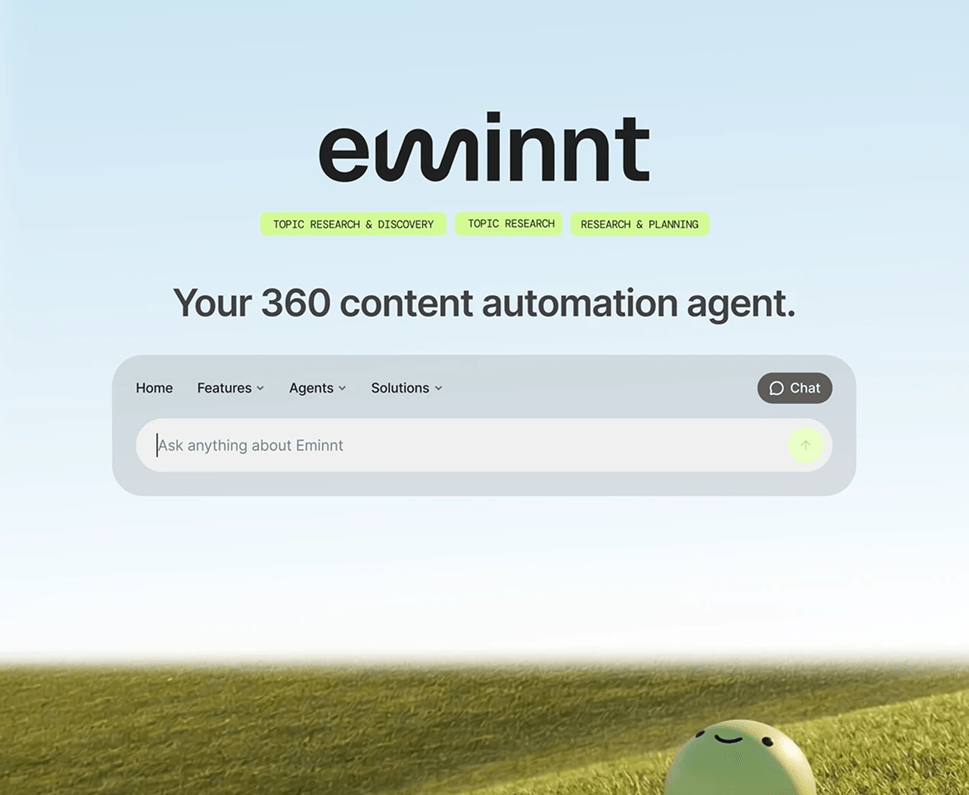
The drivers earlier in this post are easiest to see in finished work. Eminnt, a reloadux project, shows several of them at once.
reloadux made a multi-agent workflow legible with clear handoffs, states and review gates. Those are the handoff, states and review and approval drivers. Emi, the orchestrating agent, decides which agent picks up the work and when, which is the number of agents and coordination driver. An expert approves every piece before it publishes, another review and approval point built into the flow.
Conversational interfaces handle brand setup and expert interviews, and people can leave and resume them without loss. Usability testing ran across planning, drafting, review and publishing, so each stage of the workflow was checked.
Agreeing on Scope Between Engineering and Design
Engineering and design disagree on scope when each prices a different artifact. Engineers count integrations and permissions. Designers count states and flows. Neither count is wrong, but together they only describe the work if they sit in one place.
Start from the same list of scope drivers covered earlier in this post and write the scope down once. Engineering checks the drivers closest to its work, such as agents, coordination and irreversible actions. Design checks the ones closest to its own, such as handoffs, approval points, states, workflows and surfaces. Each side then reads the other's notes before anyone requests a quote.
Tradeoffs Each Side Should Name
Product owners want speed and a low number. Design leads want recovery paths that protect trust. Engineering wants a narrow permission surface to limit risk.
Cutting recovery design lowers the quote, but it moves cost to the first incident, when users cannot reverse a wrong action. Expanding too early inflates scope before you learn what users delegate. A phased plan resolves the tension. Ship one contained workflow, measure delegation, then widen.
Common Failure Modes in Agentic Scoping
Four mistakes make agentic redesign quotes hard to compare.
-
Scoping the chat window, not the workflow. The quote covers a conversation panel, but the build needs approvals and logs. Prevention: walk through the eight scope drivers earlier in this post, especially approval points, handoffs and states, before requesting estimates.
-
Treating security scoping as UX scoping. A finished security review leaves progress visibility and confirmation unpriced. Prevention: check the drivers that cover states and confidence information alongside the security review, so what people see and approve gets priced too.
-
Leaving recovery for later. The first wrong action has no undo, and trust collapses. Prevention: run the ownership sequence and design an undo pattern for every irreversible action.
-
Comparing quotes with different assumptions. One vendor includes three surfaces while another includes one. Prevention: send every vendor the same written scope built from the drivers covered earlier.
What to Settle Before You Ask for a Quote
Before you ask any vendor for a quote, write the scope down in one brief. Name the agents involved and whether one coordinates the others. Map every handoff between agent and person, and mark each approval point. List which actions can be undone and which cannot. Spell out the states the interface must show, such as working, waiting for approval, blocked and failed. Say how much confidence information users need before they act, whether sources, certainty or reasoning. Finally, list the workflows and surfaces in scope. Our UX audit checklist lists twelve questions to settle before you commit. The strongest quote is the one that lists what it excludes.
About reloadux
reloadux is an AI-native UX and product design studio, part of the Tkxel network. We have delivered 500+ products and hold a 95% client retention rate.
Our two services are AI-Native Product Design for teams building a new AI or agentic product, and AI-Ready UX Redesign for teams adding AI to an existing product, where an audit comes before any AI features.
Conclusion
Scope for an agentic UX redesign follows what the agent does, so the same product can be a small job or a large one. Settle what the agent owns and which drivers apply before you ask for a quote, then send every vendor the same written scope. That gives you comparable numbers and a shared language between engineering and design.
Want to see what this looks like on your own product? Start with a 2-day trial on one workflow: a focused UX review of one core flow plus one or two redesigned screens, through our UX redesign services.
FAQs

Saliha Shahzad
UI/UX Designer