
How AI-Powered JTBD Mapping Transformed Our UX Strategy
For most of my UX career, design analysis followed a familiar rhythm: long heuristic checklists, endless screenshots in Figma, spreadsheets packed with notes, and late-night debates over whether something was a “usability issue” or just a “business limitation”. It worked, but it was slow, opinion-heavy, and nearly impossible to scale.
At reloadux, that began to change when we introduced AI into our UX analysis and competitive intelligence workflows, anchored in the Jobs To Be Done (JTBD) framework. What followed wasn’t an overnight transformation; it was a steady evolution from manual interpretation to AI-augmented product decision-making.
This is not a story about replacing designers with machines.
It is about how we learned to use AI as a force multiplier and what actually works in real product environments.

How UX & JTBD Mapping Worked Before AI
Before AI entered our workflow, everything was deeply manual.
We would walk through every flow ourselves onboarding, checkout, dashboards, edge cases over and over again. We relied heavily on Nielsen’s heuristics, accessibility standards, and usability best practices. Every friction point was captured as a screenshot, annotated, and grouped manually.
JTBD mapping, in particular, was mostly interpretive. We inferred user jobs from stakeholder interviews, analytics dashboards, and our own experience as designers. Competitive analysis was just as manual: opening 5–10 competitors side-by-side and comparing flows, UI patterns, feature hierarchies, and messaging by eye.
This approach built strong intuition. But it also came with real limitations:
- It did not scale.
- It depended heavily on individual designer bias.
- Pattern discovery across large datasets took too long.
- JTBD statements often emerged after design ideas, not before.
We were reacting to problems rather than systematically uncovering them.
What Changed After We Introduced AI
Today, our process at reloadux is AI-assisted, JTBD-driven, and systematised. Designers still make the final calls but AI accelerates how we reach clarity.
Our current flow looks like this:
- AI-assisted product crawl
- Behavioural pattern detection
- JTBD hypothesis generation
- Human validation and refinement
- Design exploration with AI visual tools
- Final UX and product recommendations tied to growth KPIs
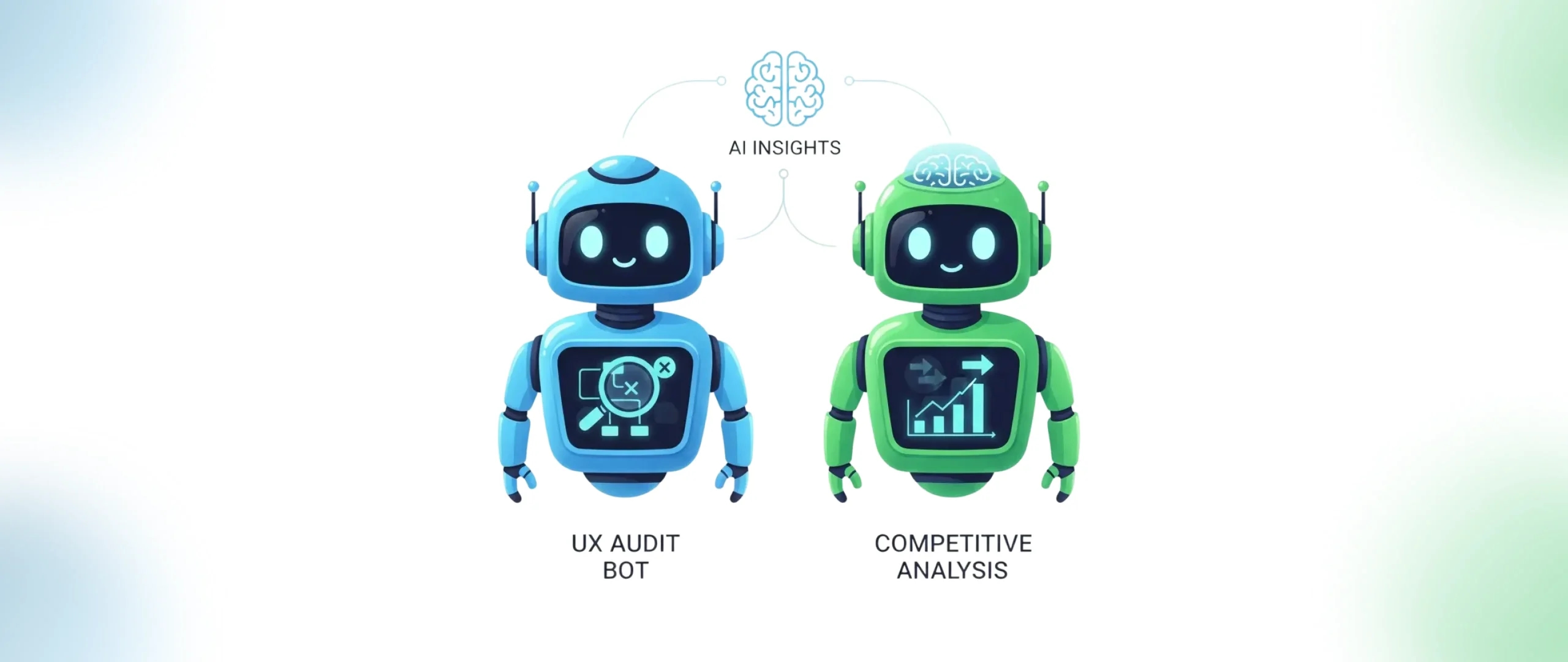
This shift became real when we built two internal systems:
One focused on deep product experience analysis, and one focused on competitive market intelligence.
Bot 1: Our AI UX Audit System (Product-Focused)
This system analyses a single product deeply and surfaces experience gaps tied directly to user jobs.
We feed it product URLs, key user flows, event analytics, session pain points, and funnel drop-offs. It then translates raw behaviour into:
- Likely user jobs
- Emotional drivers
- Friction points blocking job completion
From there, the system flags issues using established UX evaluation frameworks we already trust in practice including Nielsen Norman Group heuristics, cognitive load theory, Fitts’s Law, and WCAG accessibility guidelines.
So instead of vague “usability problems,” it specifically surfaces:
- Visibility of system status violations (users unsure what just happened)
- Recognition vs. recall breakdowns (memory-heavy interfaces)
- Unnecessary motor effort (poor target sizing or spacing)
- Error prevention gaps
- Accessibility contrast and hierarchy failures
From these, it generates framework-aligned recommendations, not abstract suggestions. For example:
- Flow restructuring based on progressive disclosure
- CTA re-prioritization using visual hierarchy and Fitts’s Law
- Layout simplification informed by cognitive load theory
- Microcopy improvements aligned with NN/g error prevention and expectation-setting principles
Before this, these checks lived only in senior designers’ heads. Now they are systematized, repeatable, and auditable, while still requiring human judgment to finalize.

Bot 2: The reloadux Competitive Analysis Agent (Market Intelligence)
This second system was never built to “scrape competitors.”
It was built to replicate how a senior product strategist studies a market faster, structured, and fully evidence-led.
Its role is simple:
Turn public competitor data into clear UX, CRO, and product decisions.
It only works with ethical, public inputs: competitor websites, pricing pages, feature pages, and public reviews. No private data. No scraping. No unflagged assumptions.
From this, it generates:
- Feature and USP matrices
- Pricing positioning snapshots
- Onboarding and activation patterns
- Review theme synthesis
But the real value appears at the JTBD layer. Instead of comparing who has more features, the system detects:
- Which user jobs are well served
- Which jobs are underserved
- Which jobs are over-engineered
This is where true market white space appears not at the feature level, but at the job-success level.
Every insight is then translated into a concrete product decision, UX direction, and expected growth impact on activation, trial-to-paid, or retention.
Before this, competitive analysis often meant feature copy-paste and reactive strategy. Now, we design against gaps, and that difference changes everything.
Where Visual AI Tools Fit: Readdy, v0, and Cursor
Once JTBD and experience gaps are clear, the next bottleneck is always ideation speed.
That is where tools like Readdy, v0, and Cursor fit into our early concept exploration layer.
We do not use them to ship final UI. We use them to think faster.
They help us instantly visualize alternate layouts, explore multiple dashboard structures in minutes, test hierarchy and density quickly, and show stakeholders three or four directions before Figma even opens.
A typical flow looks like this:
- Feed JTBD insight into v0
- Generate two to three interface directions
- Import the strongest candidate into Figma
- Apply human-level design craft
This reduces wasted production effort and increases alignment before high-fidelity design begins.

What AI Changed , And What It Didn’t
At reloadux, AI did not make us faster designers.
It made us more accountable designers.
Accountable to:
- Real user behavior
- Clear user jobs
- Evidence-based decisions
- Measurable UX impact
JTBD gave us the why.
AI gave us the scale.
Human designers still provide the judgment.
And that balance is where modern UX truly lives.

Faizan Khan
Sr. Product Designer