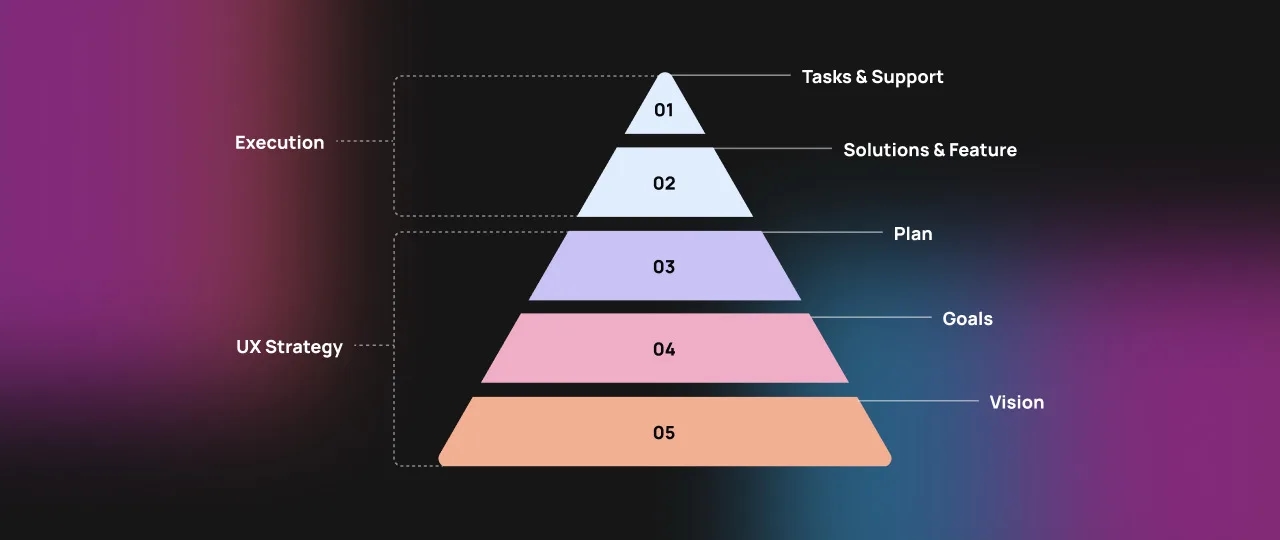
What Is a UX Design Strategy?
A UX Design strategy primarily focuses on creating a process which facilitates exceptional user experiences. It ensures that all decisions in terms of design are intentional and in accordance to the user needs and business objectives. This strategy acts as a bridge between creativity and practicality, ensuring the final product resonates with users while driving measurable results for the business.
Understanding UX Design Strategy
A UX design strategy is built on intentional decisions that align user needs with business goals, starting with a strong foundation of discovery design. Through research, user interviews, and data analysis, discovery design helps uncover real user problems early in the process. This ensures the final product is based on validated insights rather than assumptions, guiding every stage of design effectively.
A good UX strategy answers three critical questions:
What are the users’ needs and pain points?
This involves deep research to understand the target audience—who they are, what they value, and what problems they encounter and how these problems can be converted into solutions which benefit the company.
How can these needs be met effectively and intuitively?
The strategy outlines how to design solutions that are easy to use and solve user problems seamlessly while also making the general experience worthwhile enough to cause the user to come back.
How does this align with the business’s goals?
It ensures the design doesn’t just look good but also works to align the overall business objectives with the consumer needs. Not only focusing on aesthetics but functionality as well.

Key Components of a UX Strategy
- User Research: A strong UX strategy begins with understanding the people it serves. Through interviews, surveys, usability testing, and analytics, designers gain valuable insights into user behavior and preferences.
- Defining Clear Objectives: Strategy formulation does not just focus on making things usable—it’s also about solving specific problems.
- Creating a User Journey Map: Understanding the steps taken by a user in order to understand the pain points of the process.
- Prioritizing Features: Not all features are equally important. A good strategy prioritizes features that offer the greatest impact for both users and the business.
- Iterative Design Process: A UX strategy encourages continuous feedback and refinement. Prototypes and wireframes are tested early to identify what works and what doesn’t.

Why Is UX Design Strategy Crucial?
Imagine developing a product or a service without tailoring for the specific user. It would be without direction in what it wants to achieve and who it is for. This would lead to frustrated users, wasted resources and missed opportunities. Without a proper strategy, businesses run the risk of developing design that can be scattered and inconsistent.
A robust UX strategy:
- Increases Usability: It makes sure that users can direct and interact with the product effortlessly.
- Enhances ROI: More specific features tailored to user needs enhances a leaner product offering faster returns bypassing needless features.
- Aligns Teams: Align designers and developers for a shared vision. Reducing the chance of miscommunication and misunderstandings.
An Analogy to Simplify
A helpful example may be planning a trip. The traveller would know where they want to go (business goals) and how the people with them like to travel (user needs and paint points). A good travel plan promises all parties involved to enjoy the journey and reach the destination in due time. Without the strategy, this would simply not be possible.

How It Shapes Design Decisions
Every decision in the UX design process—from choosing color schemes to deciding on navigation patterns—is guided by this strategy. It answers:
- “Why are we adding this feature?”
- “How does this design choice benefit the user?”
- “Does this align with the overall business goals?”
How AI Transforms UX Design Strategy for Modern Businesses
In today’s tech-driven world, AI for UX design strategy is revolutionizing how businesses approach user experience. From collecting insights to enhancing personalization, AI has proved itself to be the difference maker in creating user-personal designs and experiences.
Refining User Research with AI
Usually, user research involves inefficient practices like interviews and surveys. AI tools, such as predictive analytics and natural language processing, can analyse user behaviour at scale, identifying patterns and pain points with incredible precision. This allows designers to observe users and tailor designs based on real-time data.

Customizing User Experiences
AI facilitates extremely high levels of personalization by taking in vast datasets and then analyzing those in order to predict user preferences. For instance, recommendation systems on entertainment platforms such as streaming services are majorly possible due to the marvels of AI.

Using AI Tools Like ChatGPT for UX Design Strategy
Generative AI tools like ChatGPT are invaluable in UX design strategy. They assist in:
- Creating user profiles on the basis of data from various user inputs.
- Generating content ideas for UI elements like microcopy, FAQs, or onboarding instructions.
- Automating tedious but repetitive tasks, which in turn increase designer productivity

AI-Powered Prototyping and Usability Testing
AI makes prototyping a more efficient process as it is effective in suggesting layouts and wireframes on the basis of already existing user data. Furthermore, AI-driven tools increase the likelihood of user interactions, identifying key usability issues and pain points before the use of real users.

Predictive Design for Future Trends
AI can analyze user data to predict future behaviors, enabling businesses to stay ahead of the curve. For instance, AI might suggest optimizing for voice search or implementing AR-based navigation based on emerging user preferences.
AI uses existing user data to predict future decisions and behaviours, helping businesses to stay ahead from competitors. For example, optimizing for voice search or implementing AR-based navigation based on emerging user preferences.

Leveraging ChatGPT to Revolutionize UX Design Workflows and Strategy
Tools like ChatGPT are reshaping how teams formulate, strategize, and deliver. Aside from its conversational talents ChatGPT can aid in many workplace tasks of different natures, enabling UX designers to be more productive.
Simplifying User Research and Data Analysis
Naive analysis of research can entail sifting through the large amounts of qualitative data from interviews, surveys and usability tests. ChatGPT can easily consolidate the feedback received and analyse recurrent issues. This contributes to the speed with which users are comprehended and the strategic plans which are based on insights.
Generating Content for UX and UI
Looking at copywriting, ranging from microcopy to onboarding messages, ChatGPT does an excellent job at creating content that fits the product’s voice and objective. For instance:
- Writing clear, concise button labels.
- Drafting engaging user onboarding scripts.
- Suggesting alternative phrasings for error messages to improve user empathy.
This guarantees that the customers get a harmonized message throughout the product, thereby improving on the flow of the product.
Designing the Concepts And Features of a Product
Ideation is a process for which ChatGPT is an excellent brainstorming tool. Designers can use it to:
- Based on the user personas, one should discover new features or functionalities.
- They can experiment with other user flows or interactions patterns.
- Create ideas for design challenges by presenting particular prompts or situations.
The tool fosters creativity and helps teams think outside the box.
Facilitating Cross-Team Collaboration
Usually, UX design is not a one-person show. Specifically, using ChatGPT in everyday working tasks will mean that instead of struggling with meeting notes, summarizing project updates, or developing detailed documentation to cover the gaps in communication between designers, developers, and stakeholders, one can just get it done with AI assistance.
Improving Accessibility and Inclusivity
ChatGPT can assist in creating inclusive design strategies by:
- Proposing more accessible substitutes for text and visual materials.
- There is the creation and realistic imitation of various user roles in order to determine which aspects of the interface may be troublesome.
This ensures designs cater to a broad range of users, regardless of their abilities or backgrounds.
Conclusion
This guide is greater than simply a tactics blueprint; It’s UX design’s cornerstone – the key for uniting clients with the right digital experiences. Whether it’s observing users to craft tailored designs, leveraging tools like ChatGPT for UX design strategy, or embracing AI-driven innovations, the goal remains the same: For integration of user needs with business objectives without any conflict as well.
As technology evolves, the integration of UX design and artificial intelligence continues to create new opportunities for delivering meaningful and engaging user experiences. When strategy is prioritized at every stage, it ensures usability is improved while keeping business goals aligned.
If you’re ready to enhance your digital presence, now is the time to act. Partner with experts, adopt a strong UX strategy, and leverage AI-driven insights to build experiences that convert, retain users, and drive long-term growth.
What are the best tools for UX design?
There are many tools for design prototyping such as Figma and Adobe XD, furthermore in terms of wireframing tools such as Balsamiq and Axure RP are the industry norm.
Why is wireframing important in UX design strategy?
Wireframing is the process of creating a basic, visual representation of a digital product, such as a website or app. Wireframing is essential in UX design strategy because it provides a clear and structured foundation for creating user-centered designs.
Can AI tools like ChatGPT improve UX design strategy?
Yes, AI tools can streamline workflows, analyze user data, generate content, and provide insights that make the design process more efficient and innovative.
What are the key elements of a successful UX design strategy?
Key elements include user research, information architecture, usability testing, iterative design, and aligning designs with business goals.

Shahmir Farooq
Sr. Communication Designer