
The tools are finally here but what about the workflows?
When our design team first began collaborating with Iman Oubou, the award-winning entrepreneur and veritable powerhouse behind Vocable, the vision was never just to build another ChatGPT wrapper.
Together, we set out to design an ecosystem that could bring order to the chaos of modern content creation: where strategy, writing, visuals, and workflows often live in separate tools and disconnected processes.
We knew from our research and discovery workshops that content creators and teams face two persistent challenges:
1. Coming up with good ideas — Creativity and brainstorming are at the heart of content creation.
2. Getting those ideas out there, consistently — Distribution and marketing are what ensure your big ideas are actually seen.
Fortunately, the second challenge was solved in the mid-2010s with the advent of bulk scheduling and analytics tools. The first had been cheerfully accepted as a necessary evil of the creative process, at least until LLMs and diffusion models suddenly went mainstream: this magical, inexhaustible, eager-to-please technology that could generate in seconds those ideas that once took hours to think of.
But the existence of this technology alone wasn’t enough. To gain real traction with creators, it needed to fit into their existing workflows: a quality only recently embraced by the leading companies shaping the future of AI interaction.

Having worked on multiple products centered around workflow automation (we recently wrote about our experience with designing trustworthy automation in fintech), we’d seen firsthand how adoption depends on your business’s ability to coexist with people’s existing habits and tools.
As user experience designers and experts in human behavior, we knew better than anyone that this principle would be just as critical for Vocable, forming the very foundation of its core functionality.
And just like that, we had our mission.

All your creative work, in one place
Vocable’s mission was to bring everything together — your strategy, content, visuals, and above all, your workflows — into one streamlined system that grows with your brand.
When everything lives in one place, context is never lost. Teams can move from ideation to publication without losing the thread of strategy or voice along the way.
From a design perspective, this meant building a foundation that felt expansive yet frictionless. The product needed to accommodate how creators already work, from brainstorming and drafting to scheduling and analysis, without forcing new habits or invoking jargon.
5 ways we made AI work for content teams
Keeping our target audience’s problems in mind, not to mention the design challenges that come with building an AI-native product, our team focused on creating a solution that felt fast, trustworthy, and genuinely useful right from day one.
Here’s a look at how we made AI work for content teams, and not the other way around.
1. Making a great first impression with onboarding
The faster you can deliver value to a customer, the more likely they are to stick around. We made sure that users see value at first contact through a simple yet effective onboarding:
- Input your brand link — Users simply paste their website or brand URL. No tutorials or forms.
- AI analyzes your brand — The system takes a moment to review tone, audience, and key brand traits, and generates a tailored summary.
- Select your platforms — Users choose where they publish to shape the content strategy.
- Generate your content plan — Within minutes, users have a content calendar that reflects their brand voice and goals, making Vocable’s value unmistakable from the start.
- The “aha!” moment — Intelligent forms convert better, cost less in support, and build trust.

2. Research and ideation, finally in the same place
Search keywords are the lifeblood of discoverable content. But for most creators and content teams, keyword research happens in a dozen different tabs and spreadsheets, all separate from where the actual writing takes place.
We wanted to fix that. So we designed a built-in keyword assistant that lives right inside the content editor. It helps creators generate keyword ideas, understand search intent, and evaluate competitiveness without ever leaving their workflow.

The results spoke for themselves on this one, too: we saw a 35% increase in workflow efficiency with this feature, proving that sometimes the best features are also the most obvious ones.
3. Unlocking new possibilities with templates
Templates let teams move faster without losing structure.
We saw how often creators waste time recreating the same types of content from scratch: product descriptions, ad copy, blog outlines, press releases. All of which follow familiar patterns, yet are constantly rebuilt. That’s where Vocable’s templates came in.
By giving creators a flexible starting point that evolves with their needs, templates became a bridge between structure and original thought.

Some might call templates shortcuts, but they’re also creative frameworks that help maintain consistency across campaigns, brands, and voices. As Twitter co-founder Biz Stone put it, “Constraint inspires creativity.”
4. Rising above the “AI slop” problem
“Slop” is the popular term for AI-generated online content, especially when perceived to be meaningless or low-effort.
The conundrum for content teams is as follows: “We want to generate our content with AI, but we don’t want it to look AI-generated.” This is where the need to humanize AI text comes in—helping content feel natural, authentic, and written for real people rather than machines.
We built this feature straight into Vocable to make their lives easier and give them full transparency into content similarity and other key metrics. Users can switch between different models and evaluate the results accordingly.

#5. Keeping it all clean with brand voice
Consistency is credibility.
For growing teams, maintaining that consistency across dozens of writers, tools, and campaigns can be a nightmare.
Big brands still struggle with it: take American Eagle’s recent “Great Jeans / Genes” campaign, where a tongue-in-cheek pun ended up confusing online audiences and clashing with the brand’s inclusive image.
Even if all publicity is good publicity, it’s a reminder for all of us that a single line of copy can drift off-brand when the tone isn’t grounded in who you are.

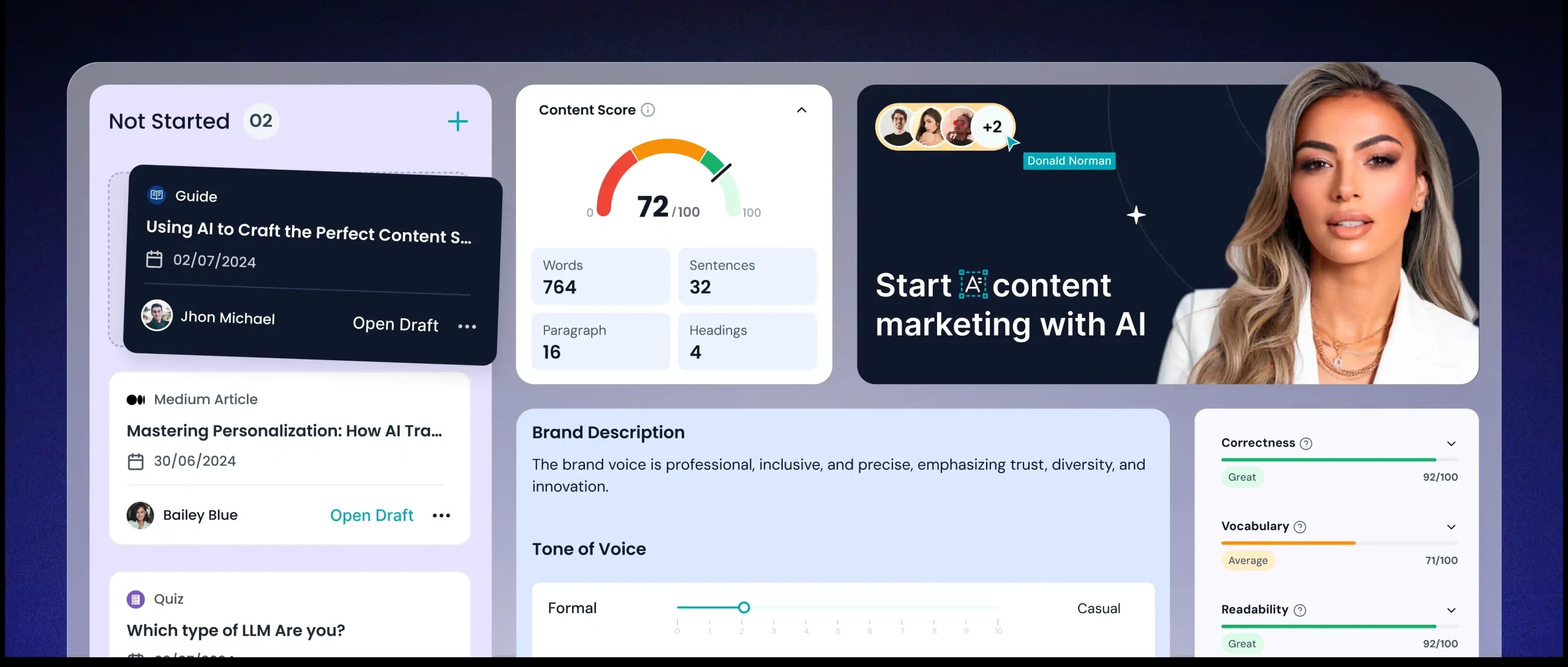
With Vocable’s Brand Voice feature, teams can define their tone, style, and messaging in one place by uploading past content, linking their website, or describing their brand personality directly. Vocable then learns what makes their voice distinct and automatically applies it across all generated outputs.

Because in the end, speed only matters if what you’re producing still feels true to who you are.
Key takeaways
Building Vocable taught us at reloadux that the future of AI content creation isn’t about replacing creativity; it’s about reinforcing it.
For creators and teams, how a tool fits into their existing habits matters more than how advanced the underlying model is. The best AI experiences don’t reinvent workflows. They respect them.
As AI becomes more deeply integrated into the tools we use every day, that will be the true differentiator. The products that win won’t be the ones with the most capabilities: they’ll be the ones that understand how humans actually work.
That belief guided every design decision we made on Vocable, and it’s what continues to shape how we build at reloadux. You can get a closer look at that journey in the full Vocable case study.

Sahar Asif
Senior Manager UX | KAM