

Introduction
Founders building AI-native products in 2026 face a harder question than which tool ships fastest. Speed to prototype stopped being the bottleneck two years ago. The real constraint now is speed to trust, and most teams still design for the wrong one. A vibe coded app retains users when its interface makes the AI's reasoning visible and controllable past the first session, not because the underlying model is impressive. That distinction determines which vibe coded projects turn into businesses and which disappear after a viral launch week.
A vibe coded app succeeds when its interface exposes what the AI is doing well enough for a user to trust the output without guessing. Founders who skip that design work ship something people try once.

Key Takeaways
- Audit your product's interface against its actual AI capability this quarter. If the model can do more than the UI explains, redesign the surface before adding features.
- Build a visible confidence signal into any AI output before launch, since users abandon features they cannot judge on sight.
- Add a human-in-loop checkpoint on any AI action tied to revenue or data, not after the first automation error costs you a user.
- Benchmark onboarding against apps that kept users past 30 days, not against apps that trended on launch day.
- Pitch investors on an experience-first narrative. Backers increasingly reward polish over raw technical novelty.
What Separates Vibe Coded Apps That Retain Users From Those That Don't
Successful vibe coded apps closed one gap. They exposed what their AI could actually do inside an interface users trusted. That gap has a name founders use openly now. Teams describe sitting on a gigantic capability overhang, meaning current AI systems can do far more than most apps built on top of them (Geekwire, 2025). The apps that broke through treated that overhang as a design brief, not a technical footnote.
This shift redefined the category. Early vibe coded projects got judged on shipping speed alone. By 2026 that standard collapsed. Founders now admit that startups can no longer expect to slap a UI on top of a GPT and get traction on their product (TechCrunch, 2026). Speed still matters, but it no longer substitutes for interface craft.
Key Research Findings
- Current AI systems outpace the apps built on them, according to founders describing a capability overhang, per Microsoft's CTO commentary.
- Startups relying on raw model capability without interface investment face the highest survival risk, per reporting on AI startup failure patterns.
- Interface-led redesigns produce measurable retention and engagement gains when the interface is rebuilt to match the AI's real capability.
The teams who understood this early designed differently. They spent time on the moment a user has to decide whether to trust an output before acting on it, using agentic workflow UX design to surface reasoning instead of hiding it. That single choice predicted retention more reliably than model choice or feature count.
Apps That Monetize Vibe Coded Workflows Share One Pattern
Apps that monetize vibe coded workflows share one pattern: they make the AI's reasoning visible before the user has to act on it.
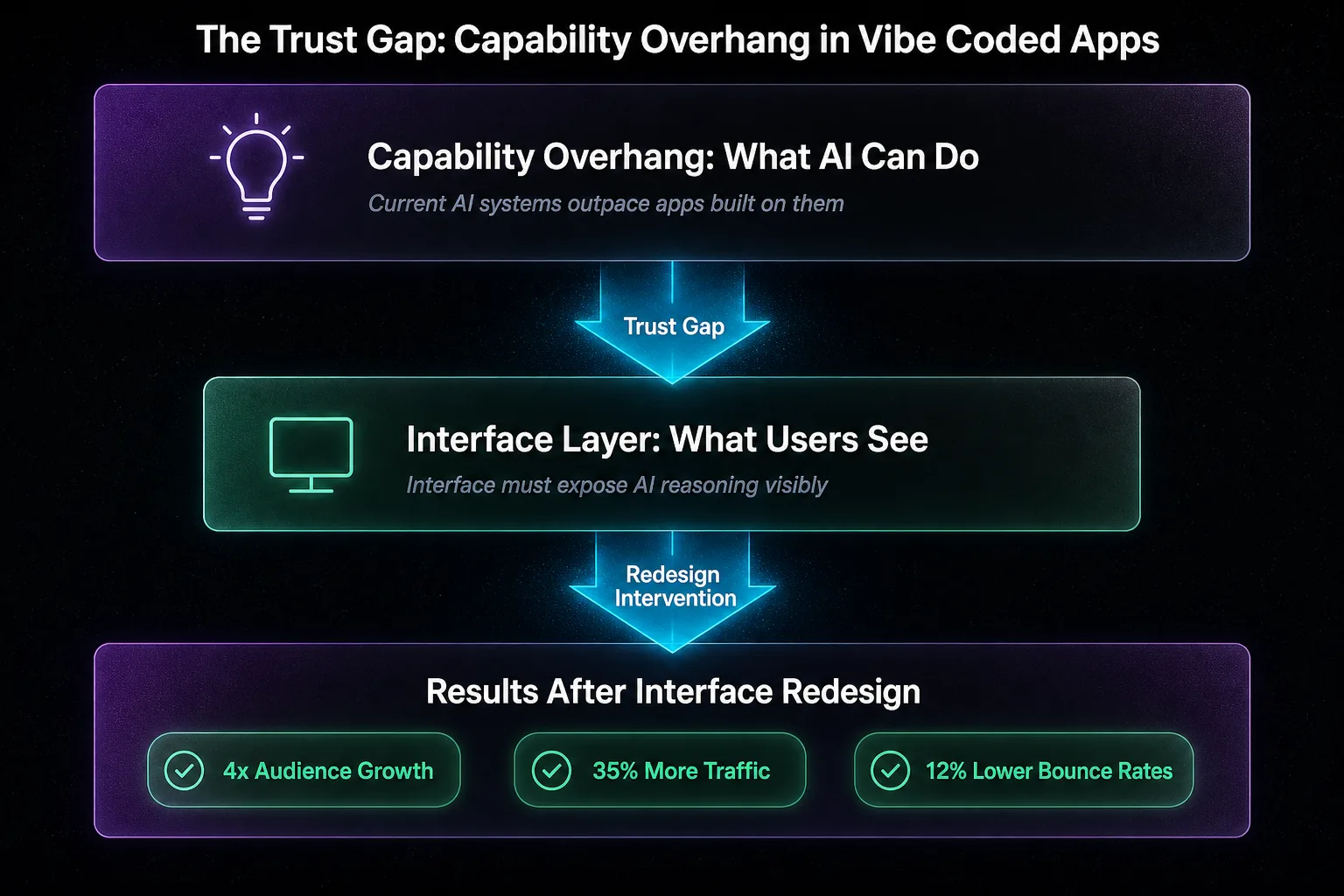
Redesign work confirms the pattern from a different angle. When a product's interface finally matches its underlying capability, growth, traffic, and retention all move together. If you are an AI-native founder raising a Series A on product traction, investors no longer accept exposed technical machinery as a product experience. Your interface needs to signal stability, not raw model power. That is the gap this article addresses.
reloadux's own work shows the same pattern. Following a redesign, Mass Media Co saw order errors fall from 25% to 2%, documented in the Mass Media Co case study. An error rate dropping is what happens when an interface stops letting users get it wrong, which is this article's argument.
What Most Vibe Coded Apps Still Get Wrong

Most vibe coded apps fail at three specific points, and none of them are model quality. They hide the AI's reasoning entirely, so users cannot tell when to trust an output. They skip human-in-loop checkpoints on consequential actions. They underinvest in the experience layer while overinvesting in feature count.
That last mistake is the most expensive because it contradicts what buyers want. Investors and enterprise buyers increasingly reject products that expose technical machinery instead of delivering a clean experience. One executive put it simply: customers want great products and features, not a reason to think about the technology behind them (Wired, 2025). A vibe coded app leading with look what the model can do instead of look what you can now accomplish is solving the wrong problem.
At reloadux, we design AI-native experiences for SaaS teams and AI-native startups building the next generation of AI-powered products. We start with Design Discovery to identify exactly where a product's AI capability outpaces its interface, then apply AI Opportunity Mapping to prioritize which surfaces need trust signals before launch. That diagnostic step catches capability-interface mismatches most teams miss until their first cohort bounces.
Product Lead Perspective on Capability Overhang
A product lead at a Series A startup sees capability overhang differently than a founder does. It is not a polish problem. It is the reason users churn. When your model generates a report but your UI forces users through fifteen dialogs to verify it, you are not shipping a feature. You are shipping friction. This is why AI feature experience design work exists specifically for products where the model has already outrun the screen built around it.
Why Interface Design Determines Whether a Vibe Coded App Succeeds
The most successful vibe coded apps design for the moment a user decides whether to trust the AI, not just the moment they first see it work. That decision point is where most products lose users, and it rarely gets design attention proportional to its importance. Founders sitting on unused AI capability should treat this as their highest-leverage fix, since current AI systems can do far more than most apps built on top of them (Geekwire, 2025).
The Patterns Behind Their Growth
Three patterns repeated across apps that retained users past their first session. They surfaced confidence signals so users knew when to verify an output. They built explicit checkpoints for consequential actions instead of full automation. They matched visual polish to technical capability instead of shipping a rough interface around a sophisticated model. Teams applying reloadux's AI-native design systems approach build these patterns in from the first sprint rather than retrofitting them after adoption stalls.
Vocable saw content efficiency improve by 300 to 500% following reloadux's redesign work, detailed in the Vocable case study.
Tradeoffs Founder-Led Speed vs. Design Partner Rigor
Founders building fast in-house often win on time to first demo. They lose on trust design, since design maturity takes deliberate practice most early teams have not had time to build. Design partners add days to the timeline but catch the interface-capability mismatch before it costs a cohort of users. Pre-seed teams validating an idea can tolerate rough edges. Teams raising a Series A on product traction cannot, since investors expect experience, not exposed technology.
Common Failure Modes in Vibe Coded Product Launches
Four failure modes repeat across underperforming vibe coded apps. Each has a specific fix.
| Failure Mode | User Impact | Prevention Strategy |
|---|---|---|
| No confidence indicator on AI output | Users cannot distinguish a reliable answer from a guess | Surface a visible confidence signal before the user acts |
| Automated consequential actions with no review step | Trust breaks the first time automation errs | Add a human-in-loop checkpoint on any action with real consequences |
| Raw model behavior exposed directly | Reads as immature to investors and buyers | Translate model output into a clear, stated outcome |
| Interface treated as a skin over the model | Guarantees the capability overhang persists | Treat the interface as the primary product surface |
reloadux's blog on why AI features feel random and the five patterns that build user confidence walks through fixes for the first two failure modes in detail.
About reloadux
reloadux designs AI-native experiences for SaaS teams and AI-native startups building the next generation of AI-powered products. The approach starts with Design Discovery to map where a product's AI capability outpaces its interface, then applies AI Opportunity Mapping to prioritize which surfaces need trust signals, confidence indicators, or human-in-loop checkpoints before launch.
reloadux holds a 4.9 rating on Clutch across more than 50 clients, a 95% client retention rate, and has delivered over 500 projects globally for teams including NBC, Barclays, and Groupon. That retention rate reflects the pattern this article describes. Products designed for trust keep users, and design partners who consistently close the capability-interface gap keep clients.
Digno saw a 15% increase in sales and a 20% reduction in operational costs following its redesign, detailed in the Digno case study.
Conclusion
Vibe coded apps that retained users in 2026 won by treating interface design as the product, not the wrapper. They surfaced reasoning, built in checkpoints, and matched visual polish to technical capability. The apps that lost user trust made the opposite bet: more features, less clarity, and a UI that never caught up to what the model could actually do.
If your team suspects its AI feature set has outrun its interface, that gap is fixable before it costs you a launch cohort. Book a discovery call with reloadux. We will map where your product's capability overhang lives and what it takes to close it before your next pitch.
FAQs

Ahmad Ullah
Principal UX Designer