

Introduction
SaaS teams shipping AI agents focus on model accuracy and ignore the two-second gap where a user decides whether to trust the output during their very first session with the agent. That gap is where agent features die quietly, long before anyone blames the model. A new user watches the agent take an action, gets no signal about why or how confident it is, and either blindly accepts the result or abandons the feature on the spot. If you want that first session to turn into a habit instead of a one-time trial, the Feature Adoption UX service covers what keeps users coming back after that first interaction.
Micro interaction design for AI agents is the practice of designing small, moment-specific signals, confidence indicators, handoff cues and uncertainty states, that let users calibrate trust in an agent’s output as it happens. This matters because an agent that acts without a visible trust signal forces the user to either blindly accept or blindly reject its output, and both responses end with the user giving up on the agent.
If you are evaluating a redesign partner before your next release, the Agentic Workflow UX service page outlines how this trust layer gets built into a product, not bolted on after.

Key Takeaways
- Replace binary trusted or blocked agent permissions with graduated confidence signals before your next agentic feature ships.
- Audit every agent touchpoint for a visible uncertainty state. If the agent cannot say I’m not sure, redesign the interaction before adding more capability.
- Build handoff cues into the interface now, not after a support escalation reveals users didn’t know a human was involved.
- Scope which agent actions are reversible and which aren’t, then match each micro interaction’s weight to that risk level.
- Apply these patterns before launch if you’re building new. If you’ve already shipped and usage has dropped, audit existing touchpoints first.
Why Binary Trust Design Fails Agentic Products

Agent trust is often designed as binary, locked or fully trusted, and that thinking shows up directly in the interface. A product either hides all agent reasoning behind a black box or dumps everything into an unreadable log.
Neither builds calibrated trust. Users need something between trust nothing and trust everything, and that middle ground is exactly what micro interaction design exists to build. When an agent’s role inside a workflow is ambiguous, the interface has to compensate with clearer signals, not fewer.
This applies whether you are building or fixing. If you’re designing an agent before launch, these patterns belong in the first prototype. If you’ve already shipped and usage has dropped, the same patterns apply as a retrofit, starting with an audit of every silent action.
How to Signal Agent Uncertainty in the Interface

The five-pillar framework above, feedback, microstate, triggers, rules, and loops, maps to the signals discussed next: feedback and microstate show up as confidence badges, triggers and rules govern when a pause appears, and loops are the narration that keeps a user oriented while the agent works.
Agentic systems start with one rule: never let silence imply confidence. Users read an unresponsive interface as either broken or finished, never as thinking carefully. Static software assumed the system only responds when clicked; an agent acts on its own initiative, often with no visible trigger. For the classic rules on this, see our post on interaction design principles.

That shift changes what a micro interaction has to communicate. It stops being you clicked, here’s the result. It becomes the agent decided to act, here’s why, and here’s how sure it is.
Without a visible confidence signal, a speed win turns into a trust liability. Three design moves do most of the work.
- Graduated confidence badges that shift color or language based on the agent’s certainty score, not a flat done state.
- Inline citations or source previews that let the user verify the agent’s reasoning without leaving the task.
- A visible pause before irreversible actions, giving the user a window to intervene before the agent commits.
Bad Interaction Design Examples in Agentic Products

Poor interaction design in agentic products traces back to one decision: treating trust as a settings toggle instead of an ongoing signal. Three failure patterns recur.
The silent-confidence failure happens when an agent completes a task with no uncertainty marker. The user assumes correctness because nothing told them otherwise. When the output is wrong, the damage compounds, because the user acted on false confidence rather than informed judgment.
Prevention: pair every agent action with a one-line narration, something like checking three calendars for conflicts.
The missing handoff cue is the second failure. An agent escalates a decision to a human teammate with no visible marker that a handoff occurred. The human is blindsided. The requester has no idea their task left automated hands, a gap explored in reloadux’s piece on designing the boundary between AI and human judgment, where unclear handoffs slow B2B deals at the exact moment trust should be reinforced.
Prevention: design a visible handoff event as a first-class UI moment, not a background log entry. Every escalation gets a visible state change both the requester and the receiving human can see.
The third failure is binary governance bleeding into the interface itself, the same locked-or-trusted pattern at the organizational level. Prevention: score every agent action on a confidence scale instead of a pass or fail gate, and expose that score to the user.
An Interaction Design Example That Works
A working interaction design example pairs every agent action with a proportional, specific signal instead of a generic loading state. An AI scheduling agent that narrates checking three calendars, resolving conflict with your 2pm gives a user three things a spinner never can. It confirms the agent is working. It names what it’s doing. It creates a window to interrupt before the conflict resolution commits.
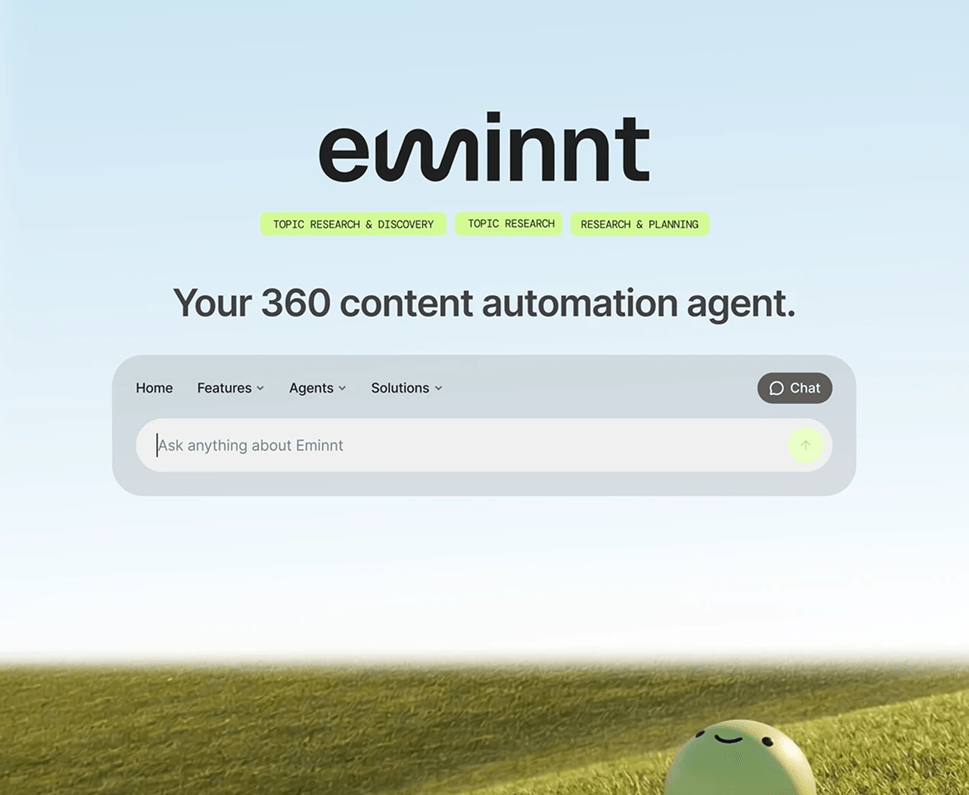
reloadux’s work with Eminnt shows the same discipline applied to a multi-agent workflow. An orchestrating agent decides which agent picks up each piece of work, so the handoff itself becomes a visible decision rather than a silent routing step. The workflow is made legible through clear handoffs, defined states and review gates, with expert approval required before anything publishes. Transparency has to be the default state, never a setting a power user digs for.
Comparing Approaches to Agent Trust Signals
| Design Approach | What the user sees | Handoff Visibility | Time to First Trust Signal |
|---|---|---|---|
| Binary trust model (locked or fully autonomous) | Nothing between locked and trusted | No defined transition point; escalations invisible | Never, failures surface only after the fact |
| Static UI retrofit (chat layer bolted on) | A confidence signal not tied to actions | Depends on manual escalation flags | Delayed, visible only after user investigates |
| Graduated micro interaction design (confidence states, visible handoffs, inline uncertainty) | A confidence signal at each action | High, handoff is a visible UI event | Immediate, signal appears at point of action |
Tradeoffs Between Speed and Trust in Agent Interface Design
The reversibility-versus-confidence-weight tradeoff shown above is the practical test for every micro interaction decision: a lightweight cue is fine for a reversible draft, but an irreversible action needs a hard pause, which is exactly what this section works through.
A founder optimizing for launch velocity wants an agent that feels instant and capable: minimal friction, minimal confirmation steps. A design lead who owns post-launch retention wants every uncertain action gated by a visible checkpoint, because one bad silent error can undo months of trust-building work. Both perspectives come from real constraints, not preference.
The resolution is scoping which actions are reversible and which aren’t, then matching the micro interaction’s weight to the action’s risk. A reversible suggestion, like a drafted email, needs a light confidence cue. An irreversible action, like sending a payment or deleting a record, needs a hard pause and explicit confirmation.
For more on reviewing irreversible actions, see our post on human-in-the-loop design.
About reloadux
reloadux is an AI-native UX and product design agency, part of the Tkxel network, that has delivered more than 500 products with a 95% client retention rate and a 4.9 rating on Clutch.
reloadux designed the agentic workflow and trust architecture for Vocable, which launched at Mindvalley’s AI Summit to more than 110,000 attendees.
Conclusion
Micro interaction design decides whether an agent keeps being used or gets ignored. The principles are direct: signal uncertainty instead of hiding it, make handoffs visible instead of silent, and scale each interaction’s weight to the risk behind it. The root cause is the same across failed agent launches, systems that force users to trust everything or nothing, with no calibrated middle ground.
If your team is scoping an agentic redesign, start with a 2-day trial on one workflow: a focused UX review of one core flow plus one or two redesigned screens.
FAQs

Sahar Asif
Studio Head