Feel like your product looks great but still falls flat with users?
That’s a common pain point and it usually signals a deeper issue: a weak or missing UX strategy.
When your product isn’t aligned with real user needs or business outcomes, you risk building something beautiful that no one actually uses. That’s where UX advisory changes the game.
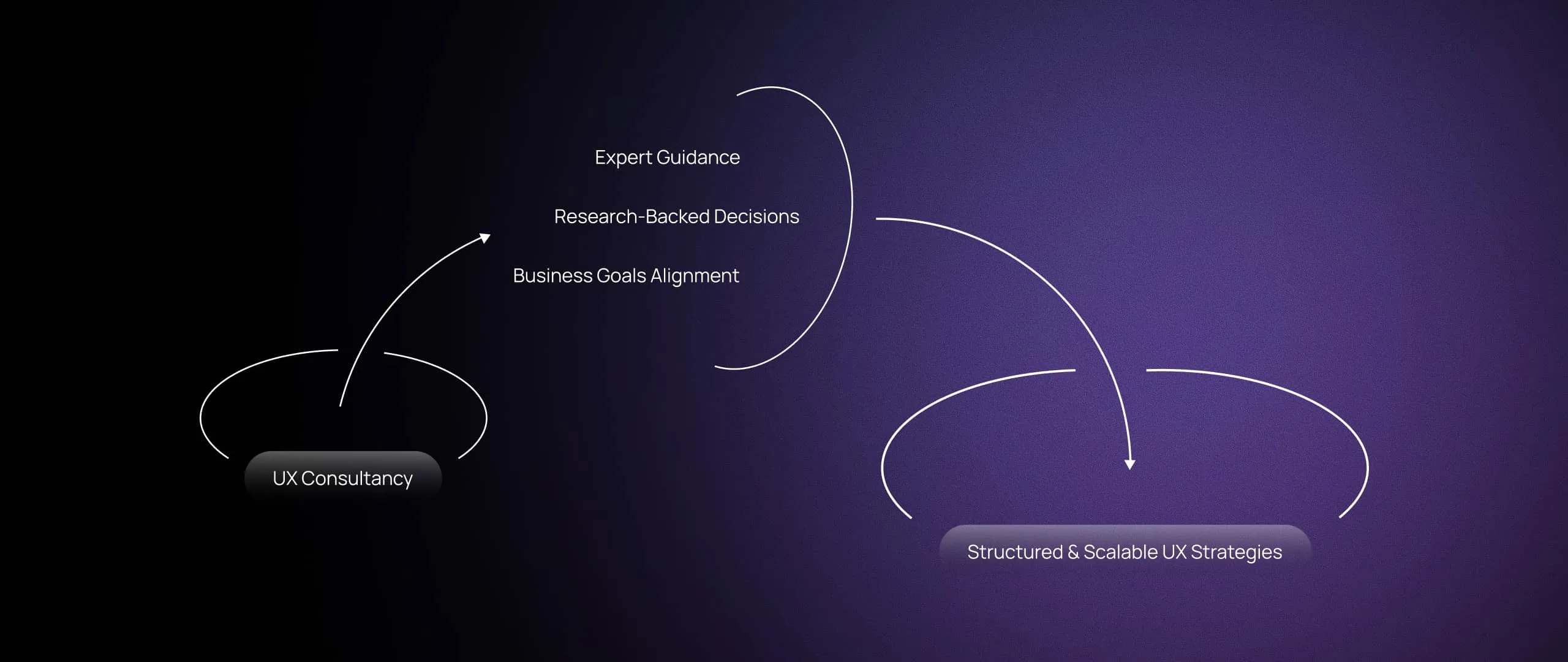
Whether you’re launching an MVP, scaling a SaaS product, or redesigning a legacy app, UX advisory provides expert guidance that turns scattered ideas into structured, scalable strategies based on user research, data, and business priorities.
Let’s explore the 5 key ways UX advisory can completely transform your product design strategy and help your team build smarter, faster, and better.

1. Aligns UX Design with Business Goals
Without alignment, even the most polished design won’t deliver business value. One of the first things a UX advisor does is connect design decisions to KPIs—whether that’s conversions, retention, activation, or NPS.
A strong UX strategy starts by answering questions like:
- What are our short- and long-term goals?
- What user behaviors drive those outcomes?
- How do we design to support those behaviors?
UX advisory brings clarity and structure to these discussions, aligning stakeholders from the start. By running workshops, analyzing existing product data, and leading cross-functional interviews, advisors help define what success looks like both for users and the business. This clarity keeps product teams from falling into the common trap of designing “cool” features that don’t actually move the needle.
It also ensures that every design iteration is tied back to a measurable outcome. When design teams understand how their work contributes to business metrics, they’re empowered to make smarter, more focused decision.

2. Drives Research-Backed Design Decisions
Designing without user research is like sailing without a compass. UX advisory ensures every decision is guided by insight, not assumption.
Advisors conduct everything from user interviews and usability tests to survey design and analytics reviews, translating complex data into actionable design strategies. For instance, frameworks around UX research and strategy help ensure your product features reflect real-world needs.

Beyond just running tests or gathering feedback, UX advisors also help teams prioritize which insights truly matter. Not all user feedback is equally valuable, and advisory brings clarity by focusing on patterns, intent, and relevance to business goals. This strategic lens helps teams avoid getting lost in vanity metrics or chasing edge-case complaints.
Additionally, UX advisory bridges the often-overlooked gap between qualitative and quantitative research. By aligning behavioral analytics with user sentiment and real-world context, advisors create a more holistic view of the user experience. This makes product decisions not only more confident, but also more defensible, especially in stakeholder discussions where data-driven rationale is key.
3. Streamlines the Product Design Process with Proven Frameworks
A UX strategy without structure is bound to become chaotic. UX advisors bring in design frameworks that streamline the entire process from idea to execution.
Popular models include the Double Diamond, Lean UX, and Jobs-to-Be-Done. These help teams avoid jumping into solutions too early and ensure designs are solving validated problems.
A typical advisory engagement includes applying these models to journey maps, wireframe flows, and content hierarchy, giving everyone a shared lens on user needs.

Your own UX design consulting services integrate these frameworks early on to help clients avoid misalignment, reduce rework, and boost speed-to-market. The result? 30% shorter release cycles and a more confident product roadmap.
4. Enhances Cross-Functional Collaboration for Smarter Decisions
One of the most transformative impacts of UX advisory lies in how it improves collaboration across diverse teams. Product design is rarely the responsibility of just one function; it involves input from product managers, developers, designers, marketers, and customer success teams. Yet, aligning all these voices can often lead to confusion, misaligned priorities, and delays. That’s where UX advisory makes a powerful difference.
By introducing structured processes like stakeholder interviews, design thinking workshops, and co-creation sessions, UX advisors help establish a shared understanding of user goals and business objectives. This ensures that everyone is working from the same playbook, reducing internal friction and promoting faster, more cohesive decision-making.

UX advisory also plays a vital role in translating research insights into practical action. Advisors help teams interpret usability data, behavior analytics, and user feedback, turning those insights into product improvements that everyone can rally behind. Instead of endless debates or guesswork, decisions start to emerge from a foundation of evidence which ultimately speeds up the entire product lifecycle.
Moreover, when product, design, and engineering teams collaborate with clear priorities and aligned expectations, it reduces rework, prevents duplicated effort, and shortens the feedback loop. The result isn’t just faster delivery, it’s more effective product outcomes that truly resonate with end users.
A strong UX strategy supported by advisory doesn’t just improve outputs; it upgrades how teams work together. With everyone pulling in the same direction, driven by real user needs, your organization becomes more agile, data-informed, and product-led at its core.
5. Future-Proofs Product Design with Scalable Systems
UX advisors think beyond the next release they plan for longevity. That’s why one of their most valuable contributions is helping you design systems that scale effortlessly as your product evolves.
Rather than tackling user experience as a series of isolated projects, UX advisory takes a systemic approach to design. This includes setting up robust design systems, enforcing consistent UI/UX patterns, conducting accessibility audits, and developing cross-platform guidelines that ensure every touchpoint feels unified, regardless of device or context. These foundations aren’t just about aesthetics; they reduce design and development time, minimize inconsistencies, and speed up onboarding for new team members.

A well-structured UX strategy often includes component libraries, design tokens, and standardized interaction models all of which live within tools like Figma or Storybook and are maintained as evolving assets. Advisors also help teams document design decisions, usage rules, and user testing outcomes so knowledge doesn’t get lost between cycles. This kind of institutional memory becomes critical when scaling across multiple product lines or feature sets.
Another key aspect is process scalability. UX advisory helps you integrate feedback loops, design reviews, and validation checkpoints directly into agile workflows. Instead of treating design as a reactive function, it becomes a proactive part of each sprint supported by repeatable systems and decision-making frameworks. This not only improves team velocity but also ensures that quality and usability never slip as complexity increases.
Crucially, by addressing scalability and governance early, UX advisory helps avoid future rework, technical debt, or design fragmentation. Whether you’re planning a multi-product ecosystem, entering new markets, or simply growing your user base, scalable design systems ensure your experience stays cohesive, consistent, and future-ready.
In essence, UX advisory gives your product a backbone, a system that grows with you, supports innovation, and keeps your team focused on creating real value, not reinventing the wheel.
UX Advisory Is the Strategy You Didn't Know You Needed
UX advisory isn’t about hand-holding it’s about empowering your product team with clarity, focus, and user-backed insight. It brings structure to vision, turns data into direction, and accelerates outcomes by removing the guesswork.
If you’re serious about designing products that deliver on both user satisfaction and business results, investing in a clear UX strategy through UX advisory could be your most strategic move yet.
Whether you’re building a first release or reinventing an enterprise platform, UX advisory helps you work smarter not harder.
What is UX advisory?
UX advisory is a consulting service where UX experts guide your product strategy using user research, business alignment, and design thinking. It’s more about what and why than just how.
Is UX advisory the same as UX design?
Not quite. A UX designer builds screens and interfaces. A UX advisor works behind the scenes, shaping direction, goals, and alignment. Think of it as the difference between an architect and a builder.
Who needs UX advisory?
Any team launching, scaling, or rescuing a digital product. It’s especially helpful for SaaS startups, enterprise redesigns, and cross-functional teams with complex user needs.
When should we bring in a UX advisor?
Early is best during discovery or MVP planning but they also help in product-market fit, churn reduction, and UX debt cleanups.
What outcomes can we expect from a UX advisory engagement?
You can expect clearer product direction, reduced design debt, faster decision-making, and better alignment across teams. Most importantly, UX advisory leads to user-centered solutions that actually move KPIs like activation, retention, and conversion.
How is a UX strategy developed during UX advisory?
The UX strategy typically starts with stakeholder interviews, competitive audits, user research, and business goal mapping. From there, advisors help define user journeys, prioritize pain points, and co-create a roadmap that aligns UX with product and growth goals.

Shahmir Farooq
Sr. Communication Designer